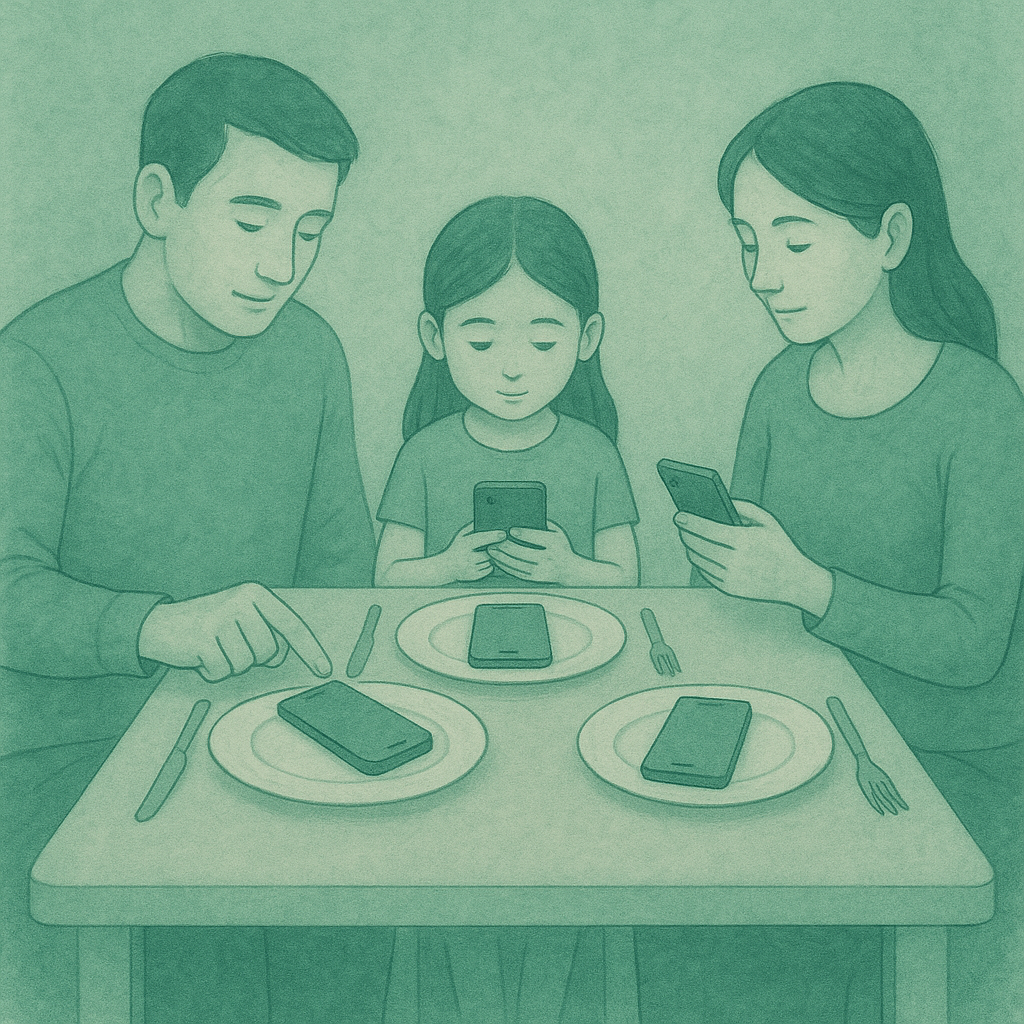
Table for Three (with phone) please!!!
On silence, screens, and what our children learn from watching us
Last night, we went out for dinner — nothing fancy, just a new place we wanted to try. The reviews said they had good fried noodles, so we thought, why not.
We were seated beside another family, also three: a father, a mother, a daughter. At first, nothing stood out. Then I noticed the silence.
No one spoke. Each had a phone propped up carefully against a cup or a plate. The glow from their screens made their faces look pale and far away.
They ate without looking at each other. The daughter scrolled, the mother watched something quietly. The father ate steadily for a while, then — about ten minutes later — he too finished, wiped his mouth, and reached for his phone.
Three people, sitting together, each in a different world.
By the time we were halfway through our meal, their plates were already empty. But they didn’t leave. Even when other diners stood waiting for tables, they stayed — still scrolling, still silent.
I found it strange, and a little sad.
At our table, my son was his usual self — scooping chili sauce for everyone, rearranging the forks, fidgeting in his seat. He eats slowly, sometimes too slowly, and always daydreams in between bites.
I used to get impatient. But recently, I’ve been trying to slow down too. Dinner is one of the most important family moments in our Asian tradition. My husband and I made it a rule — whether we eat out or stay in, we must sit down together, start together, and finish together. No one takes their meal elsewhere, and no one leaves before the others are done.
It’s a small ritual of respect — not just for the meal, but for one another.
So instead of rushing, I use this time to help my son with his sentence-building. Between mouthfuls, I’d ask him to try a new line, and he’d think hard, sometimes laugh, sometimes make up nonsense just to make me laugh.
It wasn’t neat, and it wasn’t quiet. But it felt real.
In Chinese, dinner is called 团圆饭 — tuan yuan fan.
It literally means “reunion meal,” a time when family gathers in a circle.
Our table that night was rectangular. Maybe that already says something.
Once upon a time, eating together meant more than sharing food — it meant returning to one another. But somewhere along the way, we lost that meaning. We kept the words, the customs, the red tablecloths and the chopsticks — but not the spirit.
Maybe it’s the postcolonial in-between we live in — half Western, half Asian, always trying to blend the two. We learned to use knives and forks, to speak English fluently, to keep pace with modern life. But in the process, the heart of our traditions faded.
Tuan yuan became a word we say, not a circle we feel.
As I watched that family beside us, I didn’t feel judgment — only a quiet recognition. We’re all tired, all trying to keep up, all trying to be good parents in our own ways.
But still, I couldn’t shake the thought: children only learn what they see.
If parents look to their screens for comfort, children will too.
If adults stop talking at the table, the young will learn that silence is normal.
It isn’t rebellion; it’s reflection.
And when these small, everyday silences accumulate — in thousands of homes, in countless meals — something larger begins to hollow out. The warmth that once held our families together cools quietly.
Then one day, we see the headlines — a fourteen-year-old boy stabs a sixteen-year-old girl in school. Everyone rushes to point fingers: parents, teachers, society. But maybe the fracture began much earlier, on a night like this, when a family sat together but never truly met.
Mencius once said:
“The foundation of the world lies in the nation, the nation’s in the family, and the family’s in the cultivation of oneself.”
Maybe this is what he meant — that real teaching doesn’t begin with lessons or punishments, but with how we live.
When we pick up our phones at the table, we teach disconnection.
When we stay, even in the noise and the mess, we teach love.
Dinner, after all, isn’t just about eating.
It’s a small act of cultivation — of staying human, of coming back to one another, again and again.
That night, when we finally stood up to leave, my son held my hand.
His fingers were sticky from the chili sauce he insisted on serving.
The family beside us was still sitting there, eyes on their screens.
The glow from their phones was the only light left on their table.
Ours was messy, noisy, imperfect — but full.
Reflection
Sometimes, the smallest rituals are what keep love alive.
Perhaps tuan yuan isn’t about the shape of the table at all —
but the circle we choose to form, each night, around what matters.