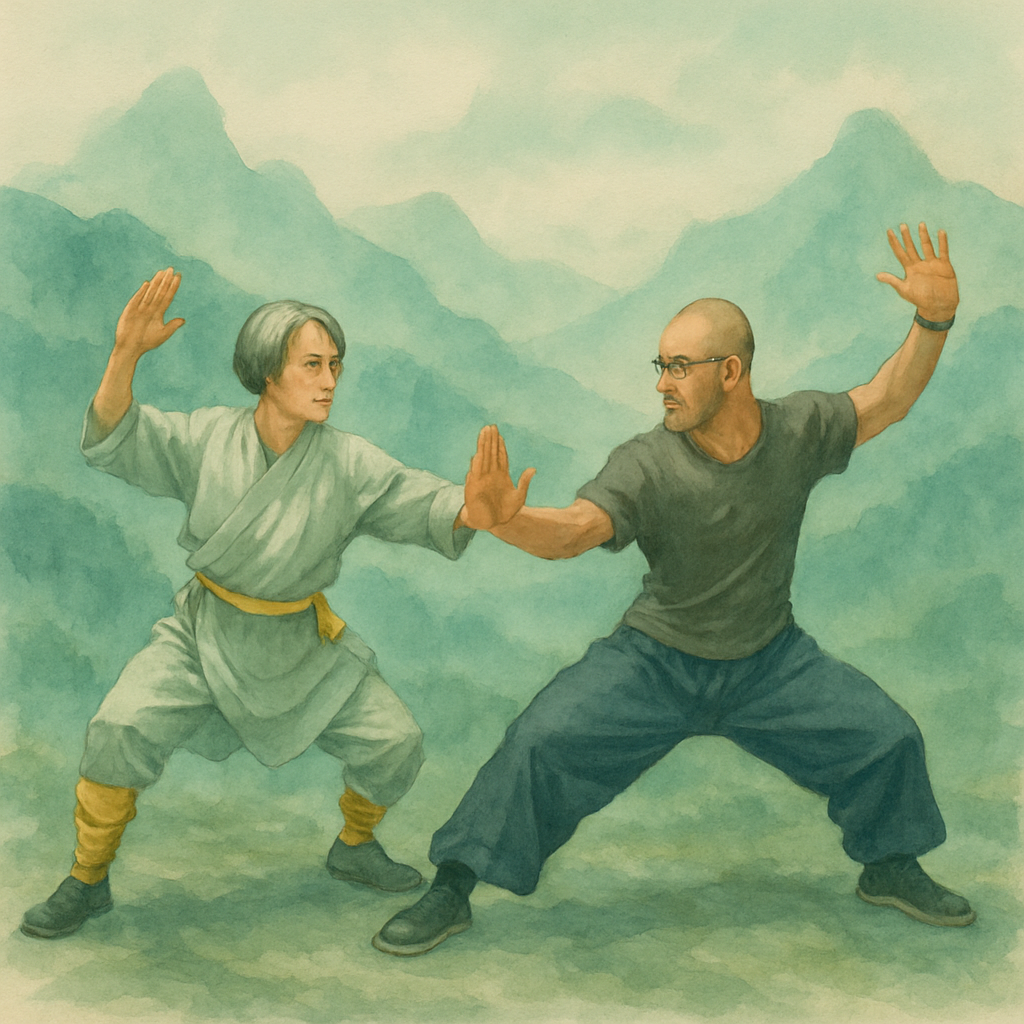
The Art of Bowing Together: What Shaolin Taught Me About Parenting
When teaching becomes learning, and parents learn to bow too.
It’s been a year since my son and I started training with our Shaolin coach.
We’ve both earned our first Duan and are now preparing for the second. Like Taichi or Karate, Shaolin martial arts also have ranks. For us, this weekly two-hour class every Sunday has become much more than physical training — it has become a journey of reflection.
I still practice three to four times a week on my own.
My son was only six when we began, right after returning from two months of training at Kunyu Mountain Academy in China. That experience marked the beginning of our Shaolin path, but it wasn’t the end — only the first step after years of trying different disciplines, from Taekwondo to Wushu. I wrote about that search in my book Different, Not Less: Bridging Western Science and Eastern Philosophy in Parenting a Hyperactive and Inattentive Child. What began as an intervention for ADHD gradually became a spiritual discipline for both of us.
The coach and the first year
When I first met our coach, I sensed immediately that he was from Mainland China. His calm authority reminded me of the masters I met in Shandong. He was surprised that I knew the technical terms of Shaolin forms — and even more surprised when he learned my son could already perform Tong Bi Quan.
At first my son joined the beginners’ class, but because I trained at the same time, we moved into the intermediate group. Most of the students there had been practicing for three years or more. I was the only adult.
At middle age, my flexibility is nothing like the children’s. I understand the philosophy deeply, but my body resists in ways theirs doesn’t. Still, my coach often said he was glad to have me in class. His school focuses mostly on children and teenagers — adults usually only attend Sanda (Chinese kickboxing) — but he believed parents should learn alongside their children.
He once told me,
“In China, you can still find seventy-year-olds doing kickboxing in the parks — strong and agile.”
Then he added,
“If parents train, children learn more than forms — they learn endurance.”
That stayed with me.
Learning beside my son
In every class, I do exactly what the coach says.
If he says, “One hundred times,” I do one hundred — slower, maybe, but I finish. I can’t do the side splits, and my kicks don’t reach my forehead, but I try with sincerity.
At first I was shy. But over time, I realized something important:
My son was watching me.
Not watching whether I was good,
but watching that I was trying.
He saw my effort.
He saw me struggle.
He saw me bow and begin again.
And in that shared effort, he received a different kind of guidance — not instruction from above, but understanding from beside him. Because I wasn’t telling him to persevere.
I was showing him.
Soon, other parents began to notice. A mother joined with her daughter. Then another father came along. Eventually, my husband — after watching us train week after week — decided to try. He now looks forward to those Sunday sessions, finding renewed energy and fitness.
It made me smile to realize that our training had quietly inspired others. A small shift had occurred:
from parents waiting outside…
to parents training inside.
When parents join the practice, the dynamic changes
This, I think, is the real lesson Shaolin gave me — and the one I didn’t fully understand until I lived it:
When parents participate in what their children do, the child receives better guidance — physically, mentally, and emotionally.
Most of us send our children to classes and expect improvement.
We sign them up for “the best coach,” or “the best school,” then wait outside while scrolling our phones.
We correct them later when they don’t meet expectations.
But before we correct them, shouldn’t we ask:
Could we do what we’re asking of them?
Training beside my son changed the entire tone of our relationship.
When he faltered, I knew exactly where and why — because I had stumbled there too.
Instead of scolding, I could guide.
Instead of pressure, there was compassion.
Instead of “Do better,” it became,
“Let’s try again together.”
He teaches me flexibility — something my old bones resist.
I teach him perseverance — something he is still learning to cultivate.
Together, we balance what the other lacks.
This is the quiet magic of shared practice:
When parents step into the same space,
children don’t feel alone.
They feel accompanied.
What Shaolin taught me about parenting
My coach always insists that I take the Duan Wei tests with my son. It’s not just formality. By learning side by side, I understand every movement he struggles with and every emotion beneath it. The physical effort becomes a mirror — reflecting the inner work of patience, humility, and endurance.
Shaolin taught me that parents aren’t meant to stand above their children, pointing the way.
We are meant to walk beside them — to bow, to sweat, to struggle, to learn again.
The practice isn’t just about strength or agility.
It’s about humility.
It’s about understanding.
It’s about shifting from hierarchy to companionship.
True teaching doesn’t begin from mastery,
but from shared effort.
Reflection
After one year of Shaolin training, I no longer see my son as a student I must mold, but as a companion in discipline and spirit. We learn differently, but we grow the same way — through practice, patience, and heart.
Maybe this is the quiet lesson all parents need:
Children don’t need perfect teachers.
They need parents willing to learn again.