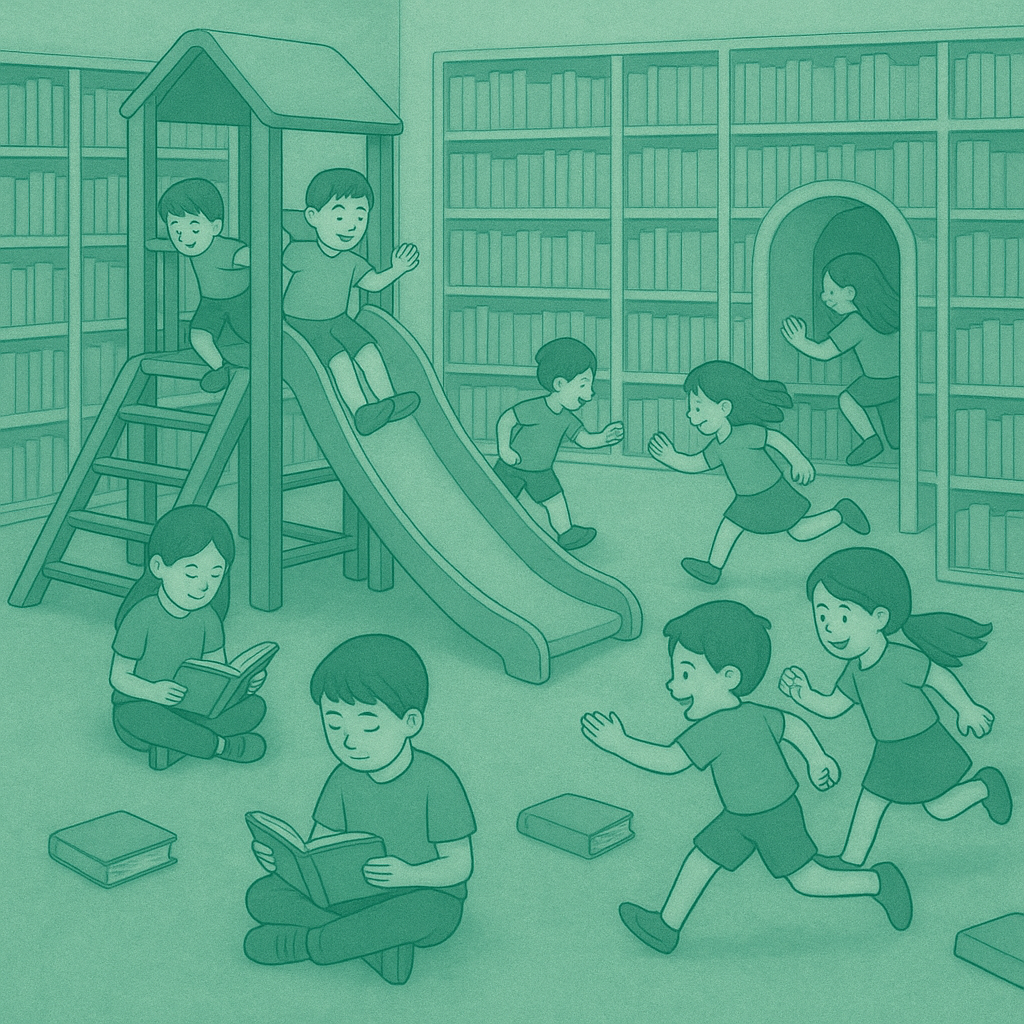
A library is meant for stillness — but what happens when the adults forget?
On stillness, example, and why children cannot love what we don’t live.
Every Wednesday, I bring my son for swimming lessons at a clubhouse. Just across the road is a beautiful public library — a serene building facing a calm lake. I always thought it was the perfect idea: before swimming, we could stroll over, borrow new books, and build a little weekly ritual of reading together.
But the moment we walked in, I was… surprised.
⸻
A library that felt like a playground
The children’s section had all the books I hoped for — Usborne Young Readers, Peter and Jane, Enid Blyton, the classics I held when I was young. I picked a small stack for my son, imagining us side by side flipping pages.
But reality was different.
Children were running across the carpet, chasing each other between bookshelves, shouting. Some were climbing the reading cubbies like play structures.
And the parents?
Most were chatting loudly, scrolling on their phones, or staring into space while their children darted around unsupervised.
There was no sense of library behaviour — no quiet corners, no gentle voices, no atmosphere of reading.
It felt like a playground dressed as a library.
I reminded myself:
Maybe I’m too strict.
Maybe modern libraries are designed to be “interactive” and “child-friendly.”
Maybe silence is considered old-fashioned now.
But inside me, there was still a soft ache — a question I couldn’t shake:
If we don’t protect places meant for stillness, how will our children ever learn to love stillness?
Over the past few years, much of my life has revolved around understanding my son’s ADHD — not as a flaw, but as a different rhythm of the mind. I wrote about that journey in Different, Not Less- Bridging Western Science and Eastern Philosophy in Parenting a Hyperactive and Inattentive Child, the long path of helping him regulate his emotions, his focus, his energy. Reading was one of the hardest parts for him. Words swam. Sentences slipped away. For a long time, books were not a joy but a frustration. It took years of steady regulation before he could even sit long enough to follow a story.
So when he finally started reading Peter and Jane — really reading, stringing words with comprehension — it felt like a quiet victory. A small breakthrough that only the two of us understood. That’s why I wanted the library to be part of our new ritual. A place where this fragile new skill could take root.
This makes what we witnessed even more striking — because a child who is just beginning to love reading needs an environment that supports stillness, not chaos.
⸻
Why bring children to a library if not to read?
There are countless places for children to play — the café, the grassy area outside, the lakeside path. But a library is one of the few remaining spaces where quiet is part of the architecture.
Quiet is not a restriction.
Quiet is an invitation.
Quiet is what allows stories to breathe.
If a library becomes loud, then children learn that noise is the default.
If adults treat the space casually, children learn that books don’t need to be handled with reverence.
Is that what we want to pass on?
Reading is not just a skill —
it is a way of being present,
a way of slowing the mind,
a way of entering another world and returning wiser.
If reading is always surrounded by distraction,
children learn to “read” with their eyes,
but not with their hearts.
⸻
When the library turned into a lesson
Then something happened right in front of us — something small, but telling.
A slightly older boy hit a younger child. The younger one screamed in shock.
My son froze beside me, eyes wide. He didn’t understand how a space filled with books had become a place of conflict.
What shocked me wasn’t the hit — children fight, children test boundaries. That’s normal.
What shocked me was the adults’ reaction.
The mother of the boy who delivered the blow wasn’t nearby.
She was sitting on the sofa chatting, completely detached. It took her a long time to walk over, as if she wasn’t sure what had happened or whether it was urgent.
Only after the crying escalated did she slowly guide her child to apologise.
And that’s when I realised something quietly painful:
Children were not misbehaving in a library.
Children were mirroring the adults.
The adults weren’t reading.
The adults weren’t present.
The adults weren’t modelling quiet, attentive behaviour.
Children can only absorb the atmosphere available to them.
⸻
The illusion that “exposure” is enough
As I watched the chaos in the children’s section, a thought suddenly came to me — one that felt almost uncomfortable to admit:
If a child sees that their parents don’t care about reading,
why do we assume that bringing them to a library full of books
will make them love to read?
But many parents truly believe this.
We think “exposure” is enough:
Bring them to the library → they will read.
Buy books → they will read.
Fill the shelves → they will read.
But children do not learn love through proximity.
They learn love through imitation.
A child looks around the library:
If Mum is scrolling her phone,
If Dad is chatting with another parent,
If no adult is holding a book or sitting quietly,
Why would the child think reading is valuable?
Where would the desire come from?
Reading is not absorbed through osmosis.
Reading is absorbed through example.
A child doesn’t think:
“This place is full of books. I should read.”
A child thinks:
“What is everyone doing here?
What matters to the adults?”
And if what matters to us is our phones —
even in a library —
we have already answered the question for them.
⸻
The love of reading is not taught — it is witnessed
Children fall in love with what their parents love.
A child who sees their parent reading feels reading as a warm place,
a safe place,
a place where the mind can rest.
But a child who sees their parent distracted or scrolling in a library
will see the library as just another place to pass time.
We can give children books,
but we cannot give them a love for books
if we ourselves do not hold that love.
They are watching us more closely than we think.
⸻
Parents cannot teach what they were never taught
And yet — this is where I feel compassion, not judgment.
Parents today bring children to libraries, enrichment classes, sports activities not because they truly model these values, but because these activities feel like “good parenting.”
It is performative parenting, not embodied parenting.
My mother-in-law once said to her eldest grandson,
“You should exercise more,”
as she watched us come back from a morning hike.
She’s very old now, and because of her age, she expects the older grandchild to set the example. She said it out of concern, not knowing how. But I had just taken all three boys — my son and his two older cousins — up the mountain near our hometown. They had fun. They were tired. They felt proud.
So I gently told her,
“It starts with the adults.
If we don’t move,
how will the children know what movement looks like?”
I wasn’t correcting her; I was reminding myself too.
Children follow who we are, not what we ask.
And the same truth hit me again in the library that Wednesday.
My son has ADHD — he gets excited easily, especially when there’s noise or movement around him. The moment he saw the other children running wildly between shelves, he became distracted too. Even though he found a book on emperor penguins he genuinely liked, we couldn’t finish reading it. The chaos around him pulled him away.
And I realised:
When one family forgets the purpose of a space,
they shape the environment for everyone else in it.
The parents who let their children run freely weren’t just affecting their own kids.
They were affecting every child who walked in hoping for a quiet corner — including mine.
It isn’t just about reading;
it’s about being considerate with the space we share.
Most of us grew up being told what to do —
not shown how to live.
So now, we repeat the same pattern,
hoping the environment will teach what we ourselves do not practise.
But children do not absorb behaviour through location.
They absorb it through example.
If parents don’t sit down, slow down, and read —
children will not magically love books.
They read our behaviour more clearly than any printed page.
⸻
What my son saw
When we left the library, my son hugged his books quietly.
He didn’t say much, but I could sense he felt the confusion too —
a library that didn’t feel like a place for reading.
And as we walked back toward the clubhouse, I realised:
Perhaps the first step is not bringing a child to a library.
Perhaps the first step is for a parent to sit down,
open a book,
and let the child see what reading looks like when it is lived.
This reflection is part of the larger journey I’ve been on with my son — the same one I wrote about in Different, Not Less. Every week, I am still learning what it means to guide him, and also what it means to grow alongside him.