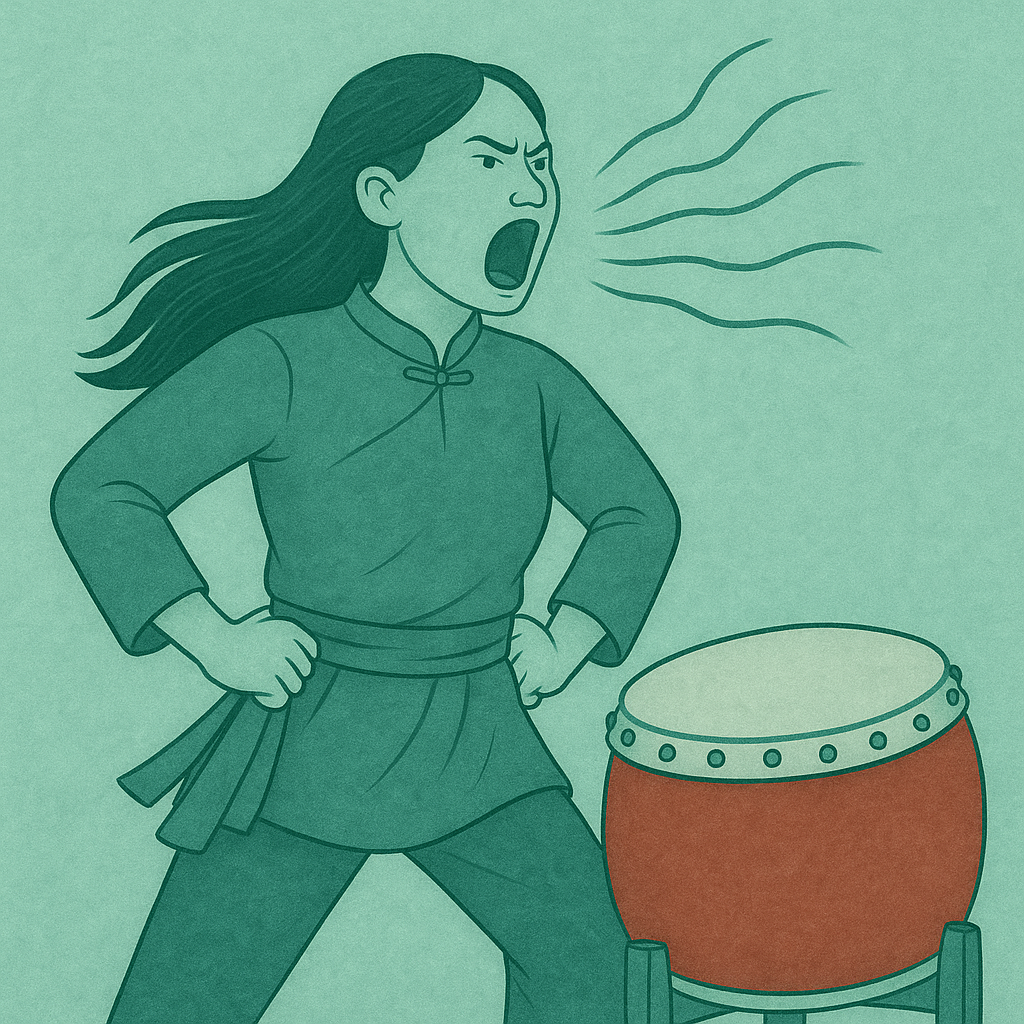
When the loudest thing in the room isn’t the drum, but the adult.
On noise, culture, and the adults children become.
Every Friday, my son attends his drum class at school as part of the extracurricular programme. It isn’t Western percussion, but the traditional Chinese drum — the deep-bodied drum used in cultural performances.
Before I ever paid attention to drumming, I only heard it as noise — loud, rhythmic, sometimes overwhelming. I’m trained as a classical pianist; to me, music was melody, phrasing, emotion. But when I learned more about the 24 Festive Drums that originated in Malaysia, I realised the drum is never just a drum. It is a vessel of rhythm, season, and intention.
Created in 1988, the 24 Festive Drums fuse three classical Chinese traditions:
狮鼓 — the lion drum, deep and commanding, traditionally used to signal movement or awakening.
书法 — the calligraphy painted on each drum, bearing one of the 24 solar terms, turning sound into meaning.
鼓阵与身法 — the choreographed movement, where drummers leap, bend and rotate in synchrony, moving like martial artists guided by rhythm.
Lion-drum. Calligraphy. Movement.
Power, spirit, rhythm.
I wish the story ended here — with culture and harmony.
But the “shouting drum” I encountered that Friday was something else entirely.
The Incident
My son was excited as usual. That morning he told me, “Mummy, coach wants to see you today.” He wasn’t sure why — performance? fees? — just that the coach had asked for me.
After lunch, we rushed to school. His favourite mixed-rice shop was closed, so we ended up waiting twenty minutes for noodle soup elsewhere, eating in ten, and changing him into his sports shirt in the car. By the time we climbed the stairs to the drum hall, we were about three minutes late.
On the way up, his friend said, “It’s not our usual coach today. Replacement teacher.”
My son whispered, “Then no need to find coach already.”
But I went up anyway — perhaps the new coach knew the reason.
What happened next stunned me.
The moment my son stepped into the hall, the replacement coach exploded.
Her voice was sharp, fierce, cutting through the air.
She shouted at him for being late — not firm, but furious.
My son froze — too young to defend himself, too shocked to speak.
She demanded, “What must you say when you are late?”
He whispered, “Sorry,” but she was already turning away.
I stood at the door. She saw me.
Yet she didn’t ask who I was or why I was there.
No courtesy, no acknowledgement.
Just a brusque wave of her hand and a dismissive: “Bye!”
I walked back down the stairs feeling angry — but also deeply sad.
Because at that moment,
the loudest thing in the room was not the drum —
it was the adult.
When Adults Forget Their Own Rhythm
The drum can be loud, but it never lacks dignity.
It commands, but never humiliates.
Its force carries meaning, not aggression.
A drum has rhythm.
But shouting has none.
And this is the part many adults forget:
children learn from the loudest adult in the room, not the wisest.
If a coach shouts, a child believes shouting is normal.
If an adult scolds without calm, a child believes losing control is acceptable.
If authority comes wrapped in volume, children learn volume is authority.
We parents can model patience and respect at home,
but the world outside has its own rhythms —
and sometimes those rhythms are harsh.
Teaching a Child to Stand on His Own Feet
Another thing stayed with me:
my own choice to stand at the door.
I didn’t rush in to explain on my son’s behalf.
Not because I didn’t care,
but because I’m trying to teach him something harder than drumming:
how to speak for himself.
Confidence doesn’t appear at eighteen.
It grows in small, uncomfortable moments:
- when an adult questions them,
- when a voice is raised,
- when they must answer on their own.
I want my son to learn to say, clearly and calmly,
“I’m sorry I’m late,”
not from fear, but from dignity.
Yet here lies the dilemma:
How do I teach him to be polite
without teaching him to accept every tone adults use?
How do I tell him to respect teachers
while also teaching him that not all adult behaviour is respectable?
This is the part of parenting no one explains.
We want our children to stand on their own feet —
but they must do it in a world that doesn’t always handle children gently.
Children Learn from Atmosphere
The more I thought about it, the clearer it became:
Parents can regulate themselves,
but children are shaped by every adult around them.
A child raised around calmness learns calmness.
A child raised around shouting learns shouting.
A child raised around dignity learns dignity.
A child raised around dismissal learns to disappear.
We often talk about children needing discipline.
But the truth is simpler and more uncomfortable:
Children absorb the discipline — or the disorder —
of the adults who surround them.
That is the real shouting drum.
Final Lines
The drum can shake a room,
but it never forgets its rhythm.
I wish the same could be said
of the adults who teach our children.