Why Our Diagnosis Answered Less Than We Hoped
There is a moment many parents of neurodivergent children eventually face:
the diagnosis.
When my husband and I realised our son was unusually hyperactive and struggled to sit still long enough to complete tasks most children could manage, we knew we were raising a very different child. Early on, our thoughts went almost instinctively to ADHD.
We first noticed that his development and behaviour diverged from what we saw in other children around the age of four.
Some parents are encouraged to seek a diagnosis early—sometimes as young as four to six—but we hesitated. Before the age of six, it is often difficult to distinguish between normal developmental immaturity and genuine executive function delays. Diagnoses made too early can be unstable and may shift as the child matures.
The same uncertainty applied to dyslexia.
Before formal literacy instruction begins, reading difficulties are difficult to interpret. Without sustained exposure to structured reading, it is hard to determine whether a child is experiencing a temporary delay or a persistent learning difference.
For these reasons, my husband and I chose to wait until our son entered Primary One.
At that stage, the demands of school—sustained attention, classroom routines, and peer comparison—made executive function gaps more visible. Teachers could offer clearer observations, and patterns were easier to discern.
At the end of his Primary One year, we finally decided to pursue a formal diagnosis.
The waiting list was six months long.
By the time the appointment arrived, however, something important had already happened.
Long before we stepped into the clinic, I had begun building my own system of regulation for my son—working through nutrition, supplementation, traditional Chinese medicine, massage, acupuncture, and carefully chosen extracurricular activities such as Shaolin, abacus, piano, art, and swimming.
I even restructured my own daily work life to function as a form of informal “day care,” creating rhythms, expectations, and support around him.
That journey eventually became a published book:
Different, Not Less: Bridging Western Science and Eastern Philosophy in Parenting a Hyperactive and Inattentive Child.
We did not pursue diagnosis because we were unaware something was different.
We pursued it because we hoped—perhaps irrationally—that once named, the problem would finally become manageable.
When we told our son we were bringing him to see a doctor, his first reaction was unexpectedly funny.
“Will I need an injection?”
When the day finally came, we arrived at the hospital to register. As we waited, a familiar question looped in my mind:
Can a doctor really understand a child in a single meeting?
One session to determine ADHD, dyslexia—even dysgraphia?
Especially when, over the past six months, I had already put in place an entire system of regulation.
From my husband’s and my own daily observations, my son had improved—not in a dramatic, overnight way, but in steady, qualitative shifts that were unmistakable if you lived with him.
The consultation began on time.
As with many paediatricians who see multiple children each day, the doctor first set up a small play mat and laid out a selection of toys. He asked my son which ones he liked.
My son chose a few, removed his shoes without prompting, and within minutes was lying comfortably on the mat, immersed in an imaginary game with an aeroplane and a truck.
The doctor then moved on to a standard patient history—when we first suspected ADHD, how his behaviour presented, what school had observed.
As the discussion deepened, I volunteered information about the interventions we had already implemented: acupuncture, nutritional support, and supplements such as magnesium, omega-3, choline, and taurine.
I also explained his convergence insufficiency—initially the reason we believed his reading difficulty was visual rather than cognitive. That issue had since been resolved to zero deviation through vision therapy, something I had documented in detail elsewhere.
I briefly mentioned my background as a pharmacist—not to assert authority, but to make it clear that these interventions were not internet-driven guesses, but clinically reasoned decisions.
The doctor nodded and recorded everything without comment.
The next phase involved literacy assessment—a series of picture-word tasks progressing from simple to more complex. There were roughly thirty to fifty items.
As the session lengthened, my son grew visibly fatigued. His focus slipped, and even the doctor struggled to bring his attention back consistently.
Initially, the doctor remarked that my son seemed able to read more words than expected, suggesting he might not be dyslexic.
But to confirm, he proceeded with a Bahasa Malaysia dyslexia assessment.
Alongside this, we discussed executive function and behavioural regulation.
I noted that one strength my son had always shown was emotional recovery. He did not have explosive meltdowns or prolonged tantrums. When dysregulated, he returned to baseline relatively quickly.
I also shared that I had chosen to step back from my career to provide full-time developmental support when he began struggling in school—not just academically, but physically and emotionally.
Learning, nutrition, sleep, and sensory regulation were treated as one integrated system.
At one point, the doctor commented that it seemed I knew what I was doing.
The formal ADHD diagnosis relied on parental questionnaires—later specified in the report as the NICHQ Vanderbilt Assessment Scale.
After nearly three hours, the results were presented.
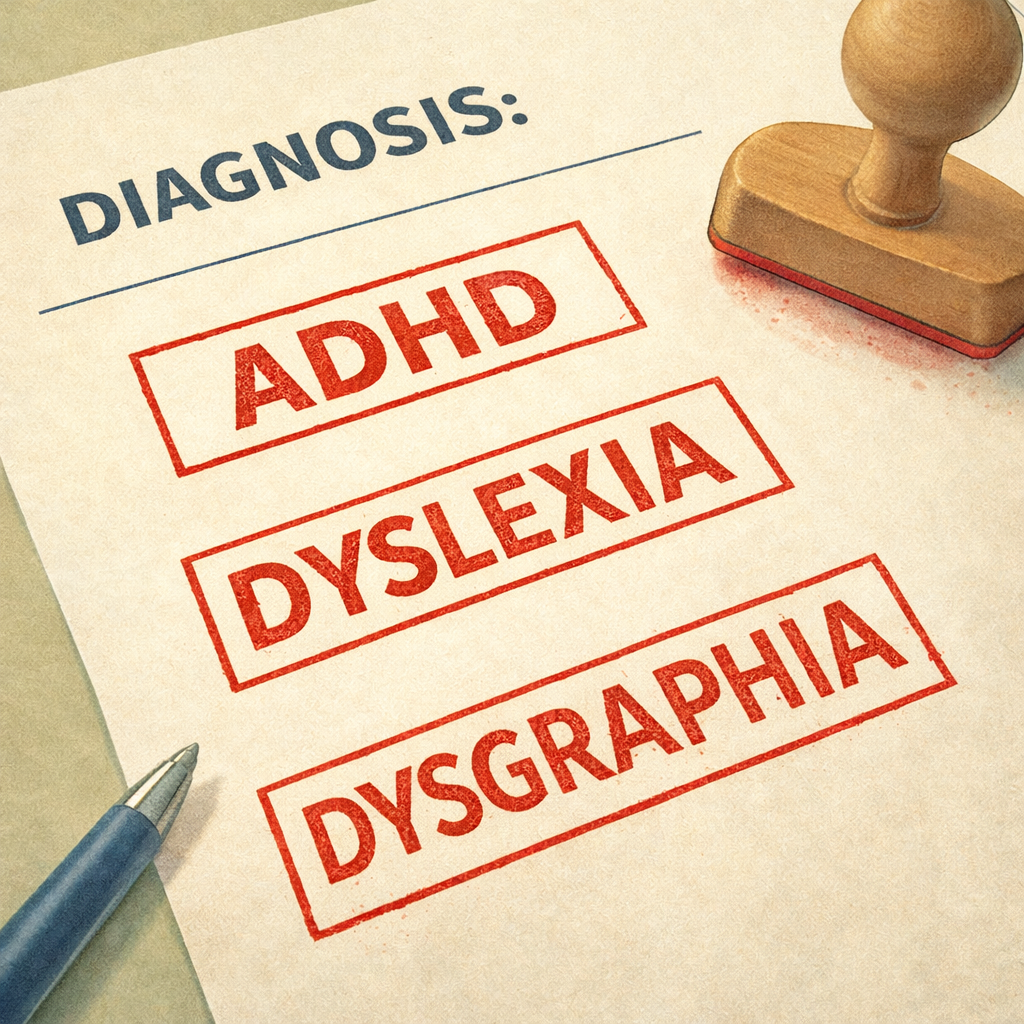
My son met criteria for ADHD.
On the Raven’s 2 assessment, his non-verbal reasoning fell in the low-average range—the 21st percentile.
His Bahasa Malaysia performance was below expected level.
The conclusion was moderately severe specific learning disorder in reading and writing—dyslexia with dysgraphia.
There was no formal assessment for Chinese literacy. The doctor explained this was outside his expertise, though he observed that my son appeared more comfortable reading logographic script than alphabetic or phoneme-based systems.
At the end of the session, I asked the question every parent asks:
What do we do next?
The answer was clear and familiar.
Ritalin was offered—to improve classroom focus for three to four hours per dose, with the caveat that appetite and sleep would likely be affected.
For dyslexia, the recommendation was an Orton–Gillingham–based intervention centre.
I nodded.
These were expected answers.
And yet, as we prepared to leave, a quiet dissonance settled in.
Ritalin might help him sit still—but what about his drifting?
His fidgeting?
His sleep architecture?
What about the slow, effortful act of reading he was already doing—Peter and Jane up to 7B—imperfectly, but steadily?
Could medication account for the progress we had already seen?
Could Orton–Gillingham explain why he was learning to read Chinese with relative ease while struggling with phoneme-based English?
Most importantly, the diagnosis told me what my son had.
It did not tell me how he learned.
It did not explain why certain interventions worked.
It did not account for what had already changed.
Those answers were not in the report.
In Part 2 under Parenting Reflections 8.1, I begin a deeper dissection of the diagnosis itself—what it captures, what it compresses, and why a single pharmacological solution became the default response to a multi-layered developmental system.